

"K-beauty" and "J-beauty" get used interchangeably in Western beauty media, the way "Italian food" and "French food" might get conflated by someone who's never eaten in either country. They're related, both descend from Asian skincare's emphasis on prevention, sun protection, and barrier care, but the texture, pace, and philosophy differ in ways that matter when you're deciding which to buy. J-beauty is the older tradition: Shiseido founded in 1872, SK-II's pitera since 1980, lineages measured in decades. K-beauty is the younger explosion: AmorePacific founded in 1945 but the global phenomenon began with BB creams ~2010, then accelerated through TikTok. Both have winnable cases. Most experienced routines mix them.
SK-II Facial Treatment Essence
90 %+ pitera (galactomyces ferment) · 230 ml · ~$185
SK-II's essence captures J-beauty's argument in one bottle: on sale since 1980, single-ingredient-led, sold at the same premium tier across regions. Korean brands iterate annually; SK-II's strategy is to perfect one essence and run it for generations.
- Decades on sale as a gentle humectant and skin softener
- Restraint built in, the bottle is the routine, no upsells
- Tolerated by sensitive skin where K-beauty actives can be too much
- $185 for 230 ml is premium; budget alternatives exist (Missha Time Revolution at $30)
- Pitera's effect is subtle, not for buyers chasing dramatic week-2 results
- Single-ingredient story limits cross-marketing; you commit to the philosophy
J-beauty's strongest products are essences and lotions, categories Western markets didn't have until K-beauty popularized them, and that J-beauty had been refining since the 1970s. The Pitera fermentation process was discovered in a Japanese sake brewery; SK-II's marketing of it (Cate Blanchett, the Crystal Clear Skin tagline) shows J-beauty's heritage-led approach. The cheaper alternatives, Missha First Treatment Essence, Klairs Supple Preparation Toner, exist because they mimic what SK-II built.
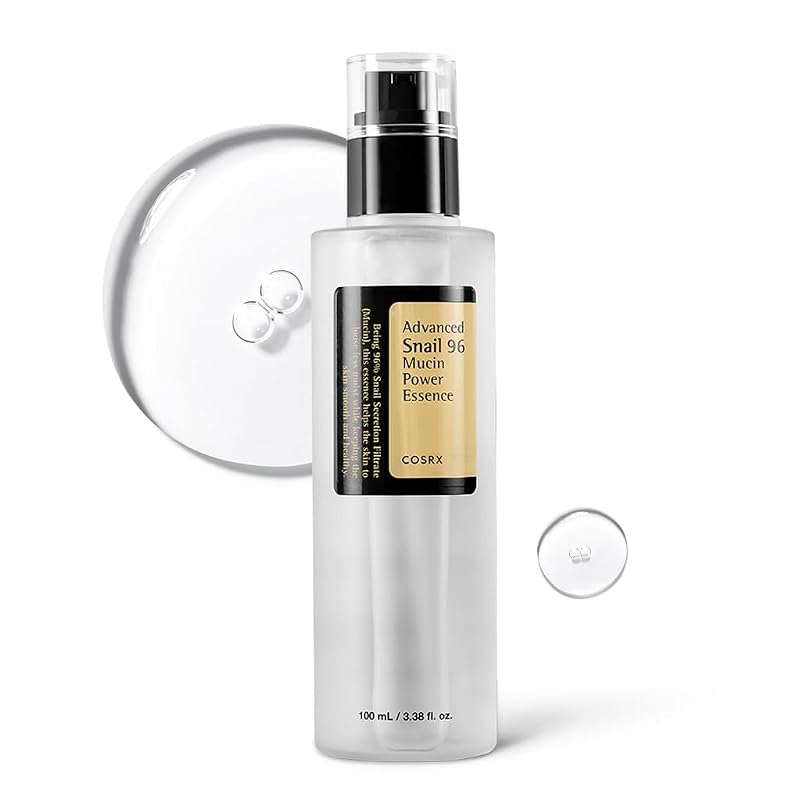
COSRX Advanced Snail 96 Mucin Power Essence
96 % snail secretion filtrate · 100 ml · ~$25
K-beauty's argument is that fast innovation beats slow refinement. COSRX's snail mucin essence went viral in 2014, has stayed viral for 12 years, and at $25 a bottle is a fraction of SK-II's price. K-beauty wins on iteration speed, social proof, and accessible price.
- Snail mucin's glycoproteins + HA + peptides outperform plain humectants
- Sub-$25 price tier is the K-beauty default, not exception
- Layered K-routines let you fine-tune by skin condition, flexibility J-beauty doesn't offer
- Trend-driven, products go in/out of stock as TikTok shifts
- Quality control variance across the long tail of new K-brands
- Step-count overwhelm; minimalist buyers should look at J-beauty instead
K-beauty's advantage is velocity. Where SK-II has spent more than 40 years on pitera, COSRX has cycled through snail mucin, BHA toners, propolis, and retinol cream since its 2013 founding. The downside is a graveyard of failed products and constant restocking anxiety; the upside is solid products at sub-$25 price points that J-beauty's heritage brands can't match. COSRX Snail Mucin Essence is the clearest example: a $25 K-beauty hero that holds its own against $80+ Western humectants.
Hada Labo Gokujyun Premium Lotion
5 hyaluronic-acid molecular weights · 170 ml · ~$19 (Japan-import)
Hada Labo's Gokujyun is the J-beauty drugstore answer to K-beauty's layered toner approach. K-beauty stacks 3-4 lighter products to build hydration; J-beauty's signature is one denser product (a 'lotion' in J-language, closer to an essence in Western terms) that does it in one step.
- One-product hydration that delivers what 3 K-beauty layers do
- Drugstore price (~$19 Japan-imported), cheaper per use than K-beauty stacking
- Less risk of pilling or texture conflicts between layers
- Less flexibility, can't fine-tune intensity day to day
- Dense texture isn't ideal for oily skin in summer
- The 'one essence does everything' approach trades adjustability for simplicity
Texture preference is the cleanest fault line between J and K. J-beauty assumes you'll buy fewer, denser products and stick with them; K-beauty assumes you'll buy more, lighter products and layer them. Neither is better in the abstract, they suit different routines and skin types. Dry, mature, or low-maintenance skin tends to do better with J-beauty's density; oily, combination, or skincare-enthusiast skin tends to prefer K-beauty's flexibility. The Hada Labo lotion above is the J-beauty drugstore exemplar; you'd need three K-beauty products (Round Lab toner + Klairs essence + COSRX ampoule) to match its hydration in one step.
Anessa Perfect UV Sunscreen Skincare Milk
SPF50+ PA++++ · water-resistant · 60 ml · ~$28
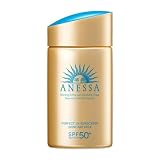
Sun protection is the one category where J and K beauty tie. Pick between them by texture preference: Anessa's water-resistant milk for outdoor use, Anua's lighter Zero-Cast for daily indoor-to-outdoor wear.
- Anessa is built for water resistance: beach, sport, sweat-prone days
- Anua Zero-Cast is the lighter daily-wear pick, with a low white cast per Anua
- Anessa's water-resistance trades for a heavier feel
- Anua's US formula uses the same FDA-approved filters as a US drugstore bottle
- Anua ships from its own Amazon store; Anessa has no US store, so every listing runs through an importer
Sunscreen is the one place where the J-vs-K distinction barely matters. The choice is contextual: if you're outdoors, in the water, or sweating heavily, Anessa's water-resistant formulation outperforms; if you're indoors with a sunlight-near-window commute and want a low white cast, Anua's Zero-Cast is the lighter daily option. Many experienced users own one of each, Anessa for beach and sport, a light daily sunscreen for everyday.
The numbers.
| J-Beauty (Japan) | K-Beauty (Korea) | Verdict | |
|---|---|---|---|
| Modern era starts | 1872 (Shiseido) | ~2010 (BB cream wave) | J: older lineage |
| Average step count | 4–6 | 7–10 | J: minimalist · K: layered |
| Hero ingredients | Pitera, rice bran, sake, camellia | Snail mucin, centella, propolis, heartleaf | Different signatures |
| Texture default | Denser, lipid-rich | Lighter, humectant-led | Different approach |
| Price tier | Often premium (SK-II $185) | Value-oriented (BoJ $18) | K: cheaper entry |
| Innovation cadence | Generational | Annual | K: faster iteration |
| Marketing tone | Heritage, science | Trend, color, community | Different audiences |
| Sunscreen style | Water-resistant (Anessa) | Light daily wear (Anua) | Tie, both excel |
| Cleanser preference | Cream / milk, single | Double-cleanse (oil + foam) | Different ritual |
| Toner shape | Dense "lotion" | Light, layered | Different goal |
| Active conservatism | Cautious (retinol as quasi-drug since 2017) | Slightly less (OTC retinol) | K: marginally permissive |
| Regulator | MHLW (quasi-drug system) | MFDS (functional cosmetics) | Different frameworks |
Other strong options.
Anua Heartleaf line
Anua is Korean by origin with J-beauty restraint in execution. Minimalist ingredient lists, dense textures, fewer products. The most J-beauty-like K-brand on the market; pairs well in either tradition's routine.
Klairs Supple Preparation Toner
Klairs is a K-brand built around the J-beauty principle: one well-formulated humectant per layer instead of three middling ones. Bridges the texture gap; works as a J-style cornerstone toner or a K-style first layer.
Innisfree Green Tea Seed Serum
Innisfree is a Korean brand that builds this serum the J-beauty way, around one heritage ingredient: green tea water and green tea seed oil from tea grown in volcanic soil, at a fraction of SK-II's price. Shows how the J/K boundary blurs at the brand level.
The buying guide.
Lean J-beauty if your skin is dry, mature, or low-maintenance
Dense, lipid-rich textures fit drier skin better. The 4–6 step routine suits buyers who don't want to layer 8 products. SK-II Pitera essence + a Curel ceramide spray + Anessa SPF is a complete routine that takes 90 seconds. If you'd rather buy fewer products and use them longer, this is your tradition.
Lean K-beauty if your skin is oily/combo or you enjoy routines
Light, layered textures fit oilier skin and humid climates better. The 7-step routine offers granularity, add an essence on dry days, skip the cream on oily ones. K-beauty's sub-$25 price tier means you can experiment without committing to a $200 cream. If skincare is a hobby, lean K-beauty.
Mix the two for the best routine
The strongest routines we recommend often combine: SK-II Pitera as the essence cornerstone (J), Beauty of Joseon Glow Serum for niacinamide (K), Curel ceramide spray for the moisturizer step (J), Anessa or Anua Zero-Cast (either). The cultural-prestige narrative on either side is marketing.
Sun protection: get one of each
Anessa for outdoor / sport / heavy-sweat conditions; Anua Zero-Cast for daily commuter wear. Both are below $30 and they cover different use cases. This is the one category where it's worth owning two products.
FAQ.
No, but the *premium tier* is more developed. J-beauty has Hada Labo at $19 alongside SK-II at $185; K-beauty has Beauty of Joseon at $18 alongside Sulwhasoo at $200. The generalization is that J-beauty leans premium-by-default and K-beauty leans value-by-default, but both ranges exist in both markets.
Yes, and most experienced routines do. The two traditions don't conflict, they share underlying principles around gentleness, sun protection, and barrier care. Common mix: Anessa SPF (J), Beauty of Joseon Glow Serum (K), Curel Japanese Skin Care moisture spray (J).
Neither is categorically better, they differ in style. Japanese sunscreens (Anessa, Biore) lean water-resistant and sport-oriented. Korean sunscreens (Beauty of Joseon, Round Lab) lean lighter-texture and daily-wear-oriented. In their home markets both use UV filters the FDA hasn't approved; some Korean brands sell US formulas with US filters through their American stores, so check the tube.
Faster innovation cycles, stronger TikTok/Instagram presence, lower price points that make 'try the new thing' affordable, and a marketing culture more aligned with social media than with editorial. J-beauty doesn't have viral hits because its strategy is to refine existing heroes rather than launch new ones.
Yes, as humectants and gentle anti-inflammatories, not as transformational actives. SK-II has sold Pitera (galactomyces ferment) as a skin softener and barrier supporter since 1980. It's not a tretinoin replacement; nothing OTC is. Frame J-beauty ferments as quality maintenance.
For dry / mature / low-maintenance skin: lean Japanese.
For oily / combo / enthusiast skin: lean Korean.
For best results: mix both.
J-beauty and K-beauty are complementary traditions that share principles and differ in execution. The cultural-prestige narratives ('Japan is more refined,' 'Korea is more innovative') are marketing copy. The deciding factor is which textures and step-counts your skin and patience can tolerate, and that's a personal calibration. Buy from both, ignore the camp loyalty, and your skin won't care which border the bottle came from.