


Korean sunscreens earned their reputation through a 20-year filter-technology gap. Korea's KFDA approved Tinosorb S, Tinosorb M, Uvinul A Plus, and Mexoryl SX as cosmetic UV filters between 2003 and 2010. The US FDA cleared Mexoryl SX only for L'Oréal products, starting in 2006, and added Tinosorb S to its sunscreen monograph in June 2026; Tinosorb M and Uvinul A Plus are still not approved there. At the bathroom counter, you get light-finish SPF50 PA++++ Korean formulas under $20 that feel like a serum, versus US Coppertone bottles at the same protection rating that leave a chalky cast and a sticky finish. Japanese-market sunscreens (Anessa, Biore, Senka) use the same filter category and frequently outperform on water-resistance for outdoor use, though the Biore sold through its US store is reformulated on US filters. One catch for US shoppers: Anua, SKIN1004 and Beauty of Joseon all sell US formulas through their American stores, built on FDA-approved filters, so check the filter list on the tube you buy. A summer sunscreen has four jobs: a no-thought daily driver for typical desk-and-coffee-shop wear, sebum control for oily and acne-prone skin, comfort on reactive sensitive skin, and a clean layering finish under makeup. Four picks for those four jobs, plus four alternatives including J-beauty heavy-duty options for hiking, swimming, and long outdoor days when the K-beauty light-finish formulas need backup.
Anua Zero-Cast Moisturizing Sunscreen SPF 50
US filters · broad spectrum SPF 50 · 50 ml · water-resistant 80 min · fragrance-free · ~$18
Anua's Zero-Cast is a Korean-brand sunscreen built for US shelves: broad-spectrum SPF 50 from US-approved filters, a low white cast on all skin tones per Anua's listing, no fragrance, and $18 a tube. 3,535 buyers rate it 4.6 stars.
- Low white cast on all skin tones, per Anua's listing
- A moisturizing finish with hyaluronic acid, glycerin, niacinamide and panthenol in the base
- Fragrance-free and non-comedogenic, per the listing
- Sold by Anua's own Amazon store, 4.6 stars across 3,535 ratings
- A moisturizing finish can shine through powder makeup on oily skin (use a mattifying pick instead)
- US filters, so it lacks the Tinosorb and Uvinul chemistry the intro describes
- No PA rating, since US labels use a pass/fail broad-spectrum test
Anua's Zero-Cast earns the daily slot on four specs: broad-spectrum SPF 50, a low white cast on all skin tones per Anua's listing, no fragrance, and $18. It is a US formula. Anua lists avobenzone, homosalate, octisalate and octocrylene as its filters, all FDA-approved, which is how it sells through Anua's own Amazon store under a US drug label. You give up the Korean filter chemistry described above, and you get a sunscreen you can buy from the brand with no importer in between. The base adds hyaluronic acid, glycerin, niacinamide and panthenol, and the tube lists 80 minutes of water resistance. For everyday wear under makeup, short stretches outside, or skincare-only days, this is the default. For long outdoor exposure with sweat, water sports, or oily-skin days where a moisturizing finish turns into shine, the next three picks cover those.
COSRX Vitamin E Sunscreen SPF 50
Chemical filters · broad spectrum SPF 50 · 50 ml · ~$18 · semi-matte finish · sold by COSRX
COSRX sells this one for oily skin, and the finish is the reason: a semi-matte natural glow that its listing says controls excess sebum and leaves no white cast. Vitamin E sits in the formula as the antioxidant. 5,201 buyers rate it 4.5 stars.
- Sold and shipped by COSRX's own Amazon store, which is the counterfeit answer in this category
- Semi-matte finish with sebum control, per the listing, instead of an alcohol-driven matte
- No white cast on any skin tone, per COSRX
- 5,201 ratings at 4.5 stars, the deepest review base of the four picks
- US filters (homosalate, octocrylene, octisalate, avobenzone), so no Tinosorb or Uvinul chemistry
- A US label, so there is no PA rating to compare against the Japanese picks
- Vitamin E is an antioxidant, not a second UV filter; buy it for the finish and the seller
Oily skin rejects sunscreen over how it feels by 3 PM. Most K-beauty sunscreens that promise a matte result get there with alcohol denat, which mattifies for an hour and can leave skin shinier by mid-afternoon. COSRX sells the Vitamin E sunscreen on a semi-matte natural glow with sebum control, and its ingredient list runs on the US filter set: homosalate, octocrylene, octisalate and avobenzone. That makes it a US product with a Korean name, which is the trade across this whole category now.
The seller is the other half of the case. COSRX ships it from its own Amazon store, while the mineral K-beauty sunscreens that used to hold this slot now sit with third-party sellers and a handful of units left, which is where counterfeits live.
For makeup days it layers better than a mineral formula. For a mineral filter specifically, buy from a brand store rather than whatever the search results offer.
Purito Sun Day Adventure Sunscreen
Chemical filters · broad spectrum SPF 50 · 50 ml · ~$18 · fragrance-free · alcohol-free · 'Daily Defense & Soft Touch'
Purito's sensitive-skin sunscreen from the rebuild that followed its 2020 SPF scandal, when the brand pulled three sunscreens after independent lab tests came in far below the label. Purito sells this one with the 'Daily Defense & Soft Touch' tagline and a clean ingredient profile to win the position back.
- Zero common irritants: no fragrance, no essential oils, no alcohol, no menthol
- Purito lists SPF testing by an independent US lab, Florida Suncare Testing
- Layers cleanly under makeup, moisturizer, or treatment
- $18 sustainable as daily wear; competitive with Anua's Zero-Cast at most retailers
- A US label, so no PA grade to compare with the Japanese picks
- Quieter finish than Anua's Zero-Cast; no dewiness, no glow
- Some US distribution gaps; check Amazon stock or YesStyle if out
Purito had to earn back its position after the 2020 recall (independent testing showed the original Centella Green Level Unscented Sun measured at SPF19 versus the labeled SPF50+). The brand's rebuild started with independent lab re-testing and ingredient simplification, and the Sun Day Adventure is one result. The sensitive-skin case: many K-beauty SPFs include a fragrance or an essential oil that can trigger reactive users. Purito's formula leaves out both. For rosacea, perioral dermatitis, recovering compromised barriers, or anyone whose previous K-beauty sunscreen produced unexplained redness, this is the swap. Its US label states broad-spectrum SPF 50 with no PA grade, so compare it on the filter list rather than on a UVA rating.
Innisfree Daily UV Defense Sunscreen SPF 50+
Chemical filters · SPF 50+ PA++++ claimed · 50 ml · ~$16 · glowy finish · no white cast
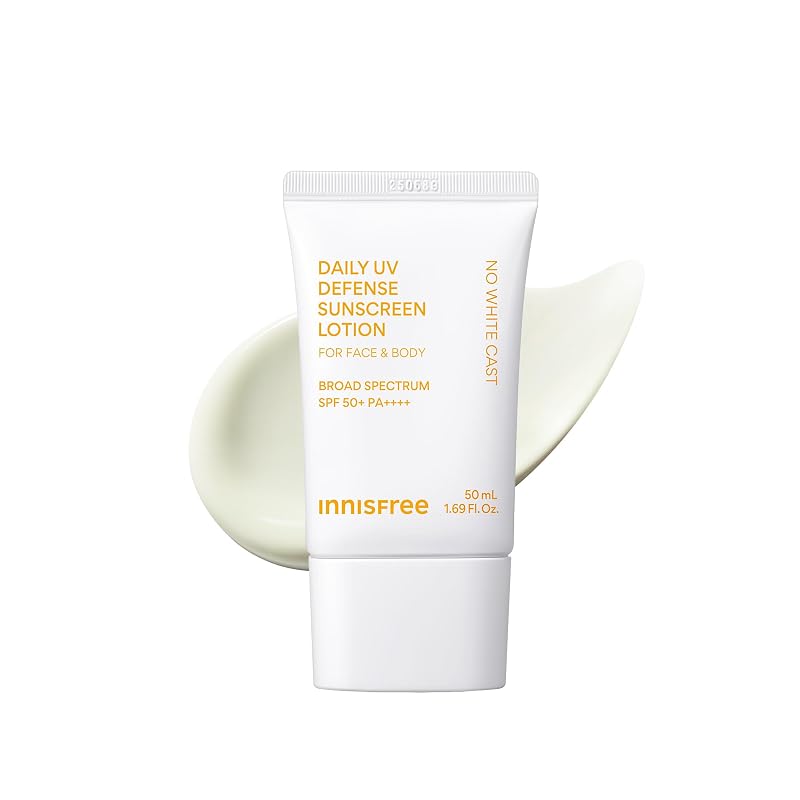
The K-beauty workhorse that sits invisibly under makeup, now on its reformulated version. Innisfree's listing calls it new and improved over the old SPF 36 lotion, claims SPF 50+ PA++++, and sells it as a base that layers without pilling. 462 buyers rate it 4.7 stars.
- Built for under-makeup use; Innisfree sells the no-pilling behavior as the main spec
- Glowy finish reads as healthy skin, not oily skin, under foundation
- Non-comedogenic and clinically tested not to clog pores, per the listing
- Shipped by Amazon at $16, the cheapest of the four picks
- The SPF 50+ PA++++ claim is Innisfree's own; the US label lists avobenzone, homosalate and octisalate
- Newer listing, so 462 ratings against thousands on the other picks
- The old SPF 36 version is still floating around other listings; check the SPF on the box you get
Innisfree's role in K-beauty is the mass-market default: the sunscreen Korean college students and office workers buy and reapply daily, while boutique products get the editorial coverage. Innisfree markets Daily UV Defense as a base that layers under makeup without pilling, and the current listing is a reformulation that the brand says replaces the older SPF 36 lotion.
The protection claim went up with it, from SPF 36 to SPF 50+ PA++++. That figure is Innisfree's, and a PA grade is a Japanese and Korean convention rather than a US one, so treat it as a brand claim and read the box when it arrives. For users who wear makeup daily and want a base that doesn't pill, slide or shine through foundation, this is still the swap.
The numbers.
| Anua Zero-Cast | COSRX Vitamin E | Purito Sun Day | Innisfree Daily UV | |
|---|---|---|---|---|
| Best for | Daily driver, all skin types | Oily / acne-prone | Sensitive / reactive | Under makeup |
| SPF / PA | 50 (US label) | 50 (US label) | 50 (US label) | 50+ / ++++ claimed |
| Filter type | Chemical | Chemical | Chemical | Chemical |
| Finish | Moisturizing | Semi-matte glow | Soft touch | Glowy |
| Fragrance | None | Not stated | None | Not stated |
| Alcohol | None listed | Not stated | None | Not stated |
| White cast | Low, per Anua | None, per COSRX | None | None |
| Volume | 50 ml | 50 ml | 50 ml | 50 ml |
| Street price | ~$18 | ~$18 | ~$18 | ~$16 |
Other strong options.
Skin1004 Madagascar Centella Hyalu-Cica Water-Fit Sun Serum
The Centella-based sensitive alternative if Purito stock runs out. Madagascar centella asiatica extract delivers anti-inflammatory support that helps post-sun skin recovery. Watery serum texture, $18, fragrance-free. The pick if your sensitivity is paired with redness or post-acne marks.
View on Amazon →Round Lab Birch Juice Moisturizing UVLOCK Sunscreen
The original K-beauty oily-skin standard, sold in the US as the SPF 45 UV Lock, reformulated on US filters for the US market per Round Lab's own listing. Birch sap base for sebum control without alcohol denat, and a lotion-like finish under makeup. Round Lab's storefront lists it, but the main buy box is often suppressed, so read the offer and the seller before you order.
View on Amazon →Anessa Perfect UV Sunscreen Skincare Milk
The Japanese heavy-duty pick for outdoor wear. SPF50+ PA++++ with Shiseido's Aqua Booster technology, which intensifies UV protection on contact with water or sweat instead of washing off. The standard for hiking, beach days, and long outdoor exposure where K-beauty light-finish formulas wash off too fast. This is the genuine Japanese formula, with Uvinul A Plus and bemotrizinol on the ingredient list, and Shiseido runs no US store for Anessa: every US listing comes through an importer, so the price (about $28 now) and the packaging generation vary.
View on Amazon →Biore UV Aqua Rich SPF 50
The J-beauty budget bridge, and the most reliable one to buy. This is the US-official Biore UV Aqua Rich, an Allure Best of Beauty winner, sold through the brand's own US storefront, so stock is dependable. Read it as a US sunscreen with a Japanese name: Kao lists avobenzone, homosalate, octisalate and octocrylene, not the Uvinul and Tinosorb filters the Japanese-market version carries. Dries to invisible, around $15, and it skips the gray-market gamble for indoor and short-outdoor use.
View on Amazon →The buying guide.
Why Korean and Japanese filter chemistry matters
The FDA added no new filter to its US sunscreen monograph from the late 1990s until June 2026, when it added Tinosorb S; Mexoryl SX reached the US only through L'Oréal-only drug approvals starting in 2006. Over that stretch, Korean and Japanese regulators approved at least seven new filters (Tinosorb S, Tinosorb M, Uvinul A Plus, Uvinul T 150, Mexoryl SX, Mexoryl XL, and others). These newer molecules absorb across the full UV-A and UV-B spectrum, sit invisibly on skin, and don't photodegrade under sun exposure the way the older US-approved filters do. The result is the visible difference at the bathroom counter: Korean and Japanese SPF50 formulas at $15-20 feel and look like serum, while US drugstore SPF50 at $15-20 leaves a chalky cast and a sticky finish.
How to read SPF and PA ratings
SPF measures UVB protection (the burn and short-wave damage). PA measures UVA protection (the long-wave damage that drives photoaging and pigmentation). SPF50 blocks ~98 % of UVB, SPF30 blocks ~97 %, so the gap between SPF30 and SPF50 is smaller than it sounds, but for daily wear SPF50 is the conservative pick. PA ratings run from PA+ (some UVA protection) to PA++++ (highest). Only Innisfree's listing claims PA++++ among the picks here; Anua, COSRX and Purito carry US labels, which state broad-spectrum SPF 50 and no PA rating at all. On a US label, broad spectrum is the only UVA signal you get, so the filter list on the back is what to read.
How much to apply
The two-finger rule: a strip of sunscreen along the length of your index finger, plus a strip along the middle finger, applied to face and neck. That's the dose used in SPF testing, which means anything less delivers a fraction of the labeled protection. Most users apply 25-50 % of the lab dose, so a labeled SPF50 delivers effective SPF15-25 in practice. The fix is mechanical: apply more, and reapply every 2 hours if outdoors.
Counterfeit risk on Amazon
Counterfeiters target K-beauty sunscreens on Amazon. Counterfeits often have correct packaging but watered-down or substituted formula, which means you get a sticky cream with no SPF protection. Risk reduction: buy from brand-direct stores (Anua, Round Lab official Amazon stores), verified K-beauty retailers (Soko Glam, YesStyle, Stylevana), or check that the seller name matches an authorized distributor list. If the price is dramatically below MSRP, assume counterfeit.
Reapplication and the makeup problem
Reapply sunscreen every 2 hours of outdoor exposure. The K-beauty solution for makeup users is sunscreen sticks (Missha All Around Safe Block Stick, TOCOBO Cotton Airy Sun Stick) that swipe over foundation without disrupting it. The Western solution is mineral powder SPF (Colorescience Sunforgettable). Both work; the K-beauty stick is cheaper per use. The non-solution is skipping reapplication because makeup is on; by mid-afternoon the morning layer has worn thin.
FAQ.
FDA approval. Sunscreen filters in the US are regulated as over-the-counter drugs and require a full drug-approval pathway with clinical trials. In June 2026 the FDA added Tinosorb S (bemotrizinol) to its sunscreen monograph, the first new filter there since the late 1990s, so US brands can now use it. Tinosorb M and Uvinul A Plus are still not approved. Korean and Japanese regulators classify these as cosmetic ingredients with safety data, which is a faster approval pathway.
Different jobs. Anua is the broader daily driver for normal-to-combination skin; Skin1004 is the sensitive-skin pick where the centella content matters for anti-inflammatory support. If your skin tolerates Anua, no reason to switch. If you've had irritation from it or you have post-acne redness, the Skin1004 swap is justified.
A finish that stays matte without leaning on alcohol denat, which controls sebum for an hour and can leave oily skin shinier by afternoon. COSRX sells the Vitamin E sunscreen on a semi-matte finish and sebum control, and it layers under makeup better than a mineral formula. If you would rather have a mineral filter, buy it from a brand store: the mineral K-beauty listings on Amazon run through third-party sellers with thin stock.
Not ideal. Anessa's Aqua Booster technology is formulated to activate on contact with water and sweat, which makes it durable outdoors but slightly heavy and shiny for indoor desk wear. For indoor / office days, the Anua Zero-Cast or Isntree Watery Sun Gel are better daily-driver picks. Anessa earns its place on outdoor days where you'd otherwise need to reapply every 90 minutes.
Buy from the brand's own Amazon store, where the byline reads Visit the (brand) Store and the seller matches the brand, or from Soko Glam and YesStyle, which source through the brands. Walk away from a listing with a generic brand name, a price far below the brand's own, or a seller name that doesn't match. Beauty of Joseon's Relief Sun is the current example: US Amazon has no genuine listing for it, and the lookalikes copy its rice-and-probiotics wording.
Daily driver: Anua Zero-Cast Sunscreen.
Oily / acne: COSRX Vitamin E Sunscreen.
Sensitive: Purito Sun Day Adventure.
Under makeup: Innisfree Daily UV Defense.
K-beauty sunscreens won the cosmetic-finish race a decade ago, and US formulators got their first new filter in decades, Tinosorb S, only in June 2026. Pick the sunscreen for the job you do most: Anua for desk-and-coffee-shop wear, COSRX Vitamin E for oily skin that shines by noon, Purito for reactive skin after the post-recall rebuild, Innisfree for daily makeup wear. The J-beauty alternatives (Anessa, Biore) cover outdoor and water-resistance use cases the K-beauty light-finish picks don't reach. Buy from brand-direct or recognized retailer accounts; Amazon has a counterfeit problem in this category.