

PDRN stands for polydeoxyribonucleotide, and it is what it sounds like: fragments of DNA, usually pulled from salmon or trout milt. Korean clinics have injected it for years under the brand name Rejuran, the treatment the internet calls a salmon sperm facial. Over the last two years the same three letters have migrated onto serums, creams, sheet masks and even a face wash you rinse off after forty seconds.
The injection and the serum share an ingredient and almost nothing else. Anything involving a needle is a medical procedure, and it belongs in a conversation with a physician. Searches of the FDA's 510(k) device database and its approved-drug database return no PDRN product, and no filing from Pharmaresearch, the company behind Rejuran.
Two questions decide whether the $19 bottles are worth it: does the molecule get into skin, and does the clinical evidence describe the molecule or the needle carrying it. We read the published trials, then read the ingredient lists on every PDRN product we could find from an official US brand store. Both answers point away from the salmon, and they decided the picks below.
These serums are pleasant, well-built and often cheap, and the ingredient on the front of the box is not the one doing the visible work. The niacinamide behind it has better evidence and, on most of these labels, a higher position. Buy on that basis and you will do fine. Pay $96 for the salmon and most of that money goes to the brand name.
medicube PDRN Pink Peptide Serum
Niacinamide 6th · Sodium DNA 8th · salmon milt extract · medicube Store · 4.6 stars, 22,932 reviews · ~$18.90
Of every PDRN product we read, medicube's serum places the DNA highest on its own label, at eighth. The niacinamide two places above it is the ingredient with the published skin data, and 22,932 buyers rate the result 4.6 stars.
- Sodium DNA at eighth is the highest placement of any PDRN product we read
- Niacinamide sits sixth, and Osamu Tanno's team at Kanebo measured nicotinamide raising ceramide synthesis four to five and a half times in cultured skin cells
- Salmon milt extract appears further down, so the salmon on the box is on the label too
- 22,932 ratings at 4.6 stars, sold by the medicube store itself
- Contains fragrance, listed near the end
- medicube gives no percentage for the Sodium DNA, so its position is all you have
- The peptides in the name sit below the preservatives
Read the label in order and the product explains itself: water, glycerin, dipropylene glycol, isopropyl myristate, glycereth-26, niacinamide, 1,2-hexanediol, Sodium DNA. The first five are water, three humectants and an emollient, which is why it feels good on skin. The sixth has evidence behind it. The eighth is the one on the front of the box.
For this category, eighth is high. Ingredient lists run in descending order of concentration down to one percent, so eighth place puts the DNA above most of the bottle's supporting cast, and medicube did not bury it at the bottom the way two other brands on this page did. Salmon milt extract shows up further along, which at least matches the marketing.
Use it the way you would use any niacinamide serum: a few drops after cleansing, morning or night, under a moisturizer. Expect what niacinamide gives you over a couple of months, which is a more even tone and a better-behaved barrier. Nineteen dollars is a fair price for that, and you can ignore the salmon.
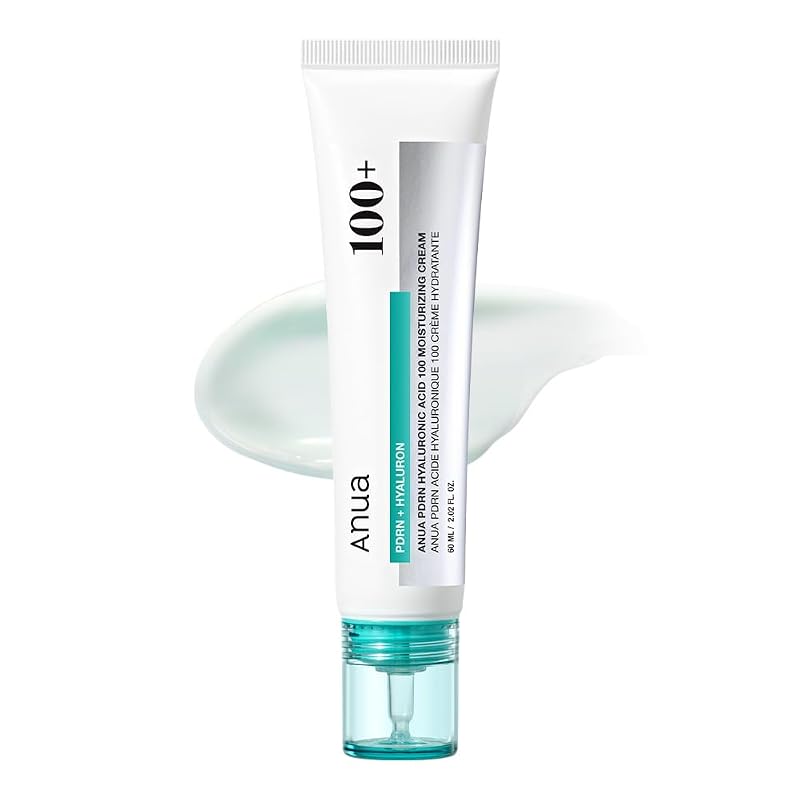
ANUA PDRN Hyaluronic Acid 100 Moisturizing Cream
Squalane 2nd · niacinamide 4th · Sodium DNA 7th · 2.02 fl oz · ANUA Store · 4.6 stars, 5,668 reviews · ~$21.60
ANUA put squalane second and niacinamide fourth, which makes this a good moisturizer before the PDRN question comes up at all. The Sodium DNA follows at seventh, higher than in Rejuran's own $75 ampoule.
- Squalane at second and glycerin at third make the base of the cream do the work
- Niacinamide fourth, above the DNA, with Kanebo's ceramide data behind it
- Hydrolyzed collagen, sodium hyaluronate and hyaluronic acid follow, all humectants that hold water at the surface
- ANUA's own US storefront, the same brand behind the Zero-Cast sunscreen we recommend
- A long tail of botanical extracts, including turmeric root and eggplant fruit, worth knowing if plant extracts irritate you
- The collagen is hydrolyzed and sits on the surface; it does not become your collagen
- About $10.70 an ounce
This is the pick if you want one product doing both jobs. Water, squalane, glycerin, niacinamide, pentylene glycol, 1,2-hexanediol, Sodium DNA: the first three make a competent moisturizer, and the fourth is the evidenced active.
The hydrolyzed collagen deserves a note, because brands lean on it. Collagen applied to skin sits on top of it as a humectant. It does not travel down and join the collagen in your dermis, and the same size argument that applies to PDRN applies to it.
ANUA is the brand behind the Zero-Cast sunscreen we moved our sunscreen picks to, and its US listings have been stable. Put this on at night over damp skin. If your skin runs oily, the medicube serum in Pick I is the lighter way into the same niacinamide.
BIODANCE Rejuvenating Caviar PDRN Real Deep Mask
48 ingredients · niacinamide 8th · Sodium DNA 48th · overnight hydrogel · BIODANCE Store · 4.6 stars, 487 reviews · ~$19
BIODANCE's hydrogel earns its reputation by sealing skin for a few hours while you sleep. Its PDRN is the last of 48 ingredients on the label, behind the tocopherol.
- A hydrogel sheet holds water against skin for hours, and occlusion is the one moisturizing mechanism nobody disputes
- Niacinamide at eighth, plus glycerin third and shea butter twelfth
- Adheres well enough to wear overnight, which is the point of the format
- 4.6 stars across 487 ratings from BIODANCE's own store
- Sodium DNA is the 48th ingredient of 48, below tocopherol and ivy leaf extract
- Salmon egg extract and caviar extract sit at 41st and 42nd, so the caviar in the name is a trace too
- Per-use cost runs well above a jar of cream
Count down the label and the story is hard to miss. Sodium DNA is the final ingredient of 48. Salmon egg extract is 41st and caviar extract 42nd, which puts all three marketing ingredients in the last eighth of the list.
Buy it anyway, for the format. A hydrogel mask worn overnight traps water against the skin, and that occlusion is why your face looks plumper at breakfast. Caviar water leads the list, glycerin is third, niacinamide eighth, shea butter twelfth. Those are the ingredients you are paying for, and they are decent ones.
Treat it as an occasional mask, the night before something matters, and not as a treatment that accumulates. What you see in the morning is water, and it fades over the day.
REJURAN Nutritive Cream
Five plant oils 2nd to 6th · Hydrolyzed DNA 26th of 32 · 1.69 fl oz · REJURAN Store · 4.6 stars, 287 reviews · ~$45.90
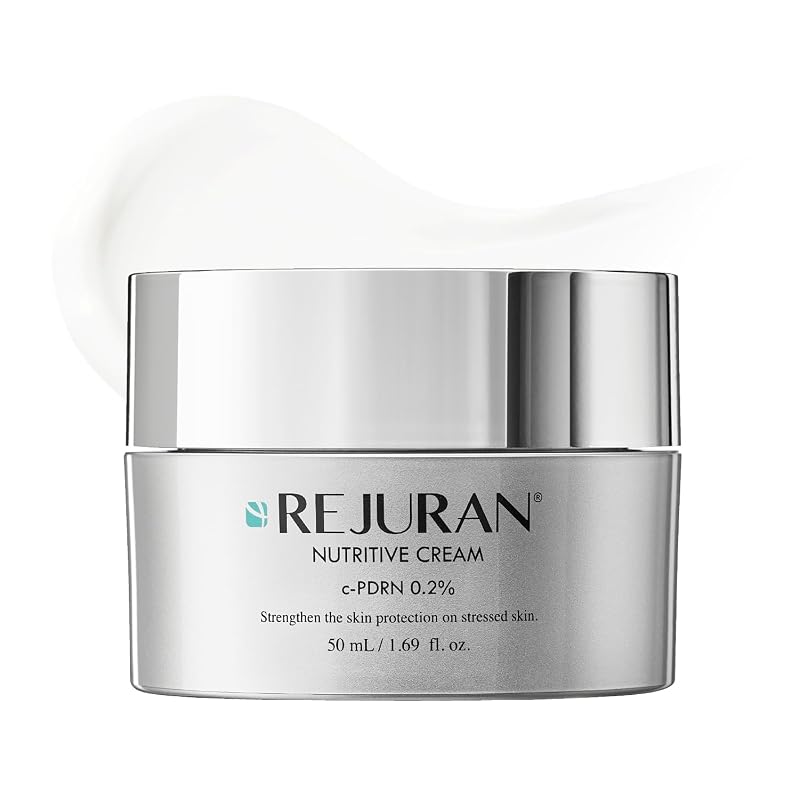
Rejuran is the brand whose injection started the PDRN story, and its cream is a rich, oil-led moisturizer. The c-PDRN it is named for sits 26th of 32 ingredients, below the phenoxyethanol.
- Five plant oils and shea butter in the first seven ingredients make it a rich cream for dry skin
- Squalane eighth and glycerin tenth support the oils
- Sold by Rejuran's own US storefront
- Panthenol and bisabolol in the formula, both used for soothing
- Hydrolyzed DNA is 26th of 32, below phenoxyethanol, which brands typically use at under one percent
- No niacinamide in the formula at all, unlike the three cheaper picks above
- Fragrance is listed, at 27th
- About $27 an ounce, roughly two and a half times the ANUA cream
The position of the preservative is the trick worth learning here. Brands use phenoxyethanol at under one percent, and Korean and EU rules cap it at one percent. Anything listed after it is present at less than that. In this cream the Hydrolyzed DNA comes after it.
That does not make the cream bad. Jojoba, pomegranate, argan, rosehip and borage seed oils, then shea butter, then squalane, is a serious emollient stack, and if your skin is dry in winter it will feel better for it. You are paying $45.90 for an oil-rich moisturizer with a famous name on the jar.
Buy it if the Rejuran name matters to you and your skin is dry. If what you want is the cream, the ANUA at $21.60 gives you niacinamide as well and costs $27 less.
COSRX Retinol 0.3% Cream
Retinol 0.3% · 0.67 fl oz · eye and neck · COSRX Store · 4.5 stars, 1,152 reviews · ~$24.65

Firmer skin and softer lines are what PDRN marketing promises. Retinoids are the molecule class with decades of trials behind those endpoints, and COSRX sells a 0.3 percent retinol cream for $24.65.
- Retinoids are the most studied topical class for wrinkles and skin texture
- COSRX states the strength on the listing, which many retinol products avoid
- Small format suits starting slowly, two nights a week
- Sold by COSRX's own store
- Retinoids irritate, especially in the first weeks, and PDRN serums do not
- Skip it if you are pregnant or nursing
- Requires daily sunscreen, without exceptions
- 0.67 fluid ounces is a small jar for the money
This pick has no PDRN in it. If your goal is the firmness and line-softening that PDRN advertising promises, retinoids are where the clinical literature sits.
Start at two nights a week on dry skin, buffer with a moisturizer if it stings, and give it three months before judging. Wear sunscreen every morning while you use it. Our treatment-heavy routine covers how to cycle a retinoid against acids without wrecking your barrier, and the sensitive reset is where to start if your skin is already reactive. Both are linked at the foot of this page.
Use it alongside a PDRN serum if you like the serum. They will not fight. Be clear about which one you are expecting results from.
The numbers.
| medicube | ANUA | BIODANCE | REJURAN | COSRX | |
|---|---|---|---|---|---|
| Format | Serum | Cream | Overnight mask | Cream | Retinol cream |
| DNA position | 8th | 7th | 48th of 48 | 26th of 32 | None |
| Niacinamide | 6th | 4th | 8th | None | None |
| Rating | 4.6 stars | 4.6 stars | 4.6 stars | 4.6 stars | 4.5 stars |
| Reviews | 22,932 | 5,668 | 487 | 287 | 1,152 |
| Street price | ~$18.90 | ~$21.60 | ~$19 | ~$45.90 | ~$24.65 |
Other strong options.
REJURAN Dual Effect Ampoule
Rejuran's $75 ampoule rates 4.6 stars across 682 reviews from the brand's own store. Its label runs water, PEG-6, glycerin, blackberry leaf extract, dipropylene glycol, butylene glycol, niacinamide, then 1,2-hexanediol, blueberry, aloe, carbomer, calendula, mulberry, licorice and squalane before Hydrolyzed DNA arrives at 16th. The niacinamide at seventh is the ingredient with published data. At $75 for 1.69 fluid ounces you are paying about four times the medicube serum for a lower DNA position.
View on Amazon →Medik8 Prismatic+ Face Serum
The $96 Western entry into PDRN, at 4.9 stars across 32 reviews from Medik8's store. Water, glycerin, niacinamide, lactobacillus ferment, centella, lactobacillus extracellular vesicles, then DNA at seventh. The niacinamide at third is the highest placement of any product on this page, so the formula is sound. You are paying for the brand, and medicube's $18.90 serum puts the same two ingredients in a comparable order.
View on Amazon →VT COSMETICS PDRN 100 Essence
VT's essence rates 4.6 stars across 2,787 reviews at $21, and its listing advertises 100,000 ppm PDRN, which is ten percent. The ingredients field on Amazon reads 98% wild ginseng concentrate 100,000ppm PDRN, Cerasome Complex, panthenol, squalane, allantoin. That field is marketing copy with no INCI order, so there is no way to check the claim against the label the way we did for everything else here. Buyers like it. We cannot verify what is in it.
View on Amazon →Olay Retinol Night Cream MAX
The drugstore route to a retinoid at $34.94, rating 4.6 stars across 12,215 reviews from the Olay store. It pairs retinol with niacinamide in a fragrance-free base, which suits skin that finds a straight retinol cream harsh. Olay does not publish the retinol percentage. Buy it over the COSRX if you want a full-face night cream instead of a small jar for eyes and neck.
View on Amazon →The buying guide.
What PDRN is, and where it comes from
Polydeoxyribonucleotide is a mixture of DNA fragments, extracted in practice from the milt of salmon or trout. A 2025 review in Biomolecules by Marques and colleagues puts the usual molecular weight range at 50 to 1,500 kilodaltons, and notes that the terms PDRN and polynucleotide get used interchangeably in the literature for polymers of different lengths, which muddies comparisons between studies. The proposed mechanism runs through the adenosine A2A receptor and the nucleotide salvage pathway: the fragments are meant to calm inflammation and hand cells raw material for repair. That mechanism comes from injection and wound-healing work.
The size problem
Jan Bos and Marcus Meinardi at the University of Amsterdam set out the 500 Dalton rule in 2000: a compound needs a molecular weight under 500 daltons to cross the stratum corneum, and larger molecules do not pass. Their evidence was that nearly all common contact allergens, all standard topical dermatology drugs and all transdermal delivery agents sit under that ceiling. PDRN at 50,000 to 1,500,000 daltons is 100 to 3,000 times over it. Nothing about a serum base changes arithmetic on that scale. Brands work around this with liposomes and nano prefixes on the label, and none of the products here publish data showing how much intact PDRN reaches living skin.
The clinical evidence is about needles
Lampridou and colleagues published a systematic review of polynucleotides in aesthetic medicine in the Journal of Cosmetic Dermatology in 2025. Searching Embase, Medline and Cochrane, they found nine studies of low and moderate quality covering 219 patients, all receiving injections, and concluded that rigorous high-quality studies are still needed to validate effectiveness and safety. Two of the four authors disclose paid relationships with a polynucleotide manufacturer. The single most-cited trial, a 2014 phase III comparing Rejuran against a hyaluronic acid filler on crow's feet, has since been retracted, and even as published it reported no statistical significance between the two groups on its primary or secondary efficacy measures.
What topical studies exist
Two, and neither supports the serum on your shelf. Kim and colleagues published work in Molecules in 2022 on a topical mixture of PDRN, vitamin C and niacinamide that improved pigmentation and elasticity in UV-B irradiated mice. They delivered it with a microneedling system, which is a set of needles, and they combined it with two ingredients that have their own evidence, so the result cannot be assigned to PDRN. Bak and colleagues published a 2025 study in the International Journal of Molecular Sciences on a peony-derived PDRN, reporting faster barrier recovery in a detergent-damage model across ten subjects and better periorbital elasticity at four weeks. Every author on that paper works for the company commercializing the ingredient.
Decode the ppm number
Brands print PDRN concentrations in parts per million because the numbers look enormous. Convert them: 100,000 ppm is 10 percent, 10,000 ppm is 1 percent, and 5,000 ppm is 0.5 percent. A listing advertising 100,000 ppm is claiming a ten percent ingredient, which would place it near the top of an ingredient list. Check whether it does. On every label we could read, the DNA sat seventh or lower, which is not where a ten percent ingredient lives.
Read the label instead of the box
Ingredient lists run in descending order of concentration until you reach one percent, after which brands may list in any order. Two practical rules follow. First, find the DNA: it appears as Sodium DNA, Hydrolyzed DNA or DNA on its own, and its position tells you more than the front of the box. Second, find the preservative, usually phenoxyethanol, which brands use at under one percent. Anything listed after the preservative is present at less than that. In the Rejuran Nutritive Cream, the Hydrolyzed DNA comes after it.
Why these products still work
Niacinamide sits above the DNA on almost every label here, and it has the evidence PDRN lacks in topical form. Osamu Tanno's team at Kanebo reported in the British Journal of Dermatology in 2000 that nicotinamide raised ceramide synthesis four to five and a half times in cultured human keratinocytes, and that applying it to dry skin raised barrier lipids and lowered water loss. Add glycerin, squalane and hyaluronic acid holding water at the surface, and you have a product that makes skin look better through mechanisms nobody disputes. None of that requires the salmon.
FAQ.
It behaves as a humectant at the skin surface, a modest benefit. Brands sell it for remodeling and regeneration in the dermis, which requires reaching the dermis, and at 50,000 to 1,500,000 daltons it is 100 to 3,000 times above the 500 dalton ceiling Bos and Meinardi described for skin penetration. No brand on this page publishes data showing intact PDRN crossing into living skin.
Yes. An injection places the material into the dermis and skips the barrier that stops the serum. That is also what makes it a medical procedure, and it belongs with a physician. Nearly all the clinical evidence for PDRN comes from injections, and a 2025 systematic review characterized it as nine low-to-moderate-quality studies covering 219 patients.
Ten percent. Parts per million divided by 10,000 gives you the percentage. A ten percent ingredient would normally appear near the top of an ingredient list, so compare the claim against the label. Where we could read the label, the DNA sat seventh or lower.
The products here are sold as cosmetics and their ingredients are common in that category. If you have a fish or shellfish allergy, talk to a doctor before using a salmon-derived product, and patch test. Anyone considering injections should raise it with a physician first.
No. A cleanser is on your face for under a minute and then goes down the drain. Whatever case exists for a leave-on PDRN product disappears in a rinse-off one.
A retinoid at night, sunscreen every morning, and three months of patience. Retinoids carry the clinical evidence for wrinkles and texture that PDRN marketing borrows. Pick V is a reasonable starting strength, and our treatment-heavy routine covers how to introduce one without irritating your skin.
Buying one thing: medicube PDRN Pink Peptide Serum, $18.90.
If you want a cream: ANUA PDRN Hyaluronic Acid 100, $21.60.
If you want the effect PDRN advertises: COSRX Retinol 0.3%, $24.65.
Buy the medicube serum at $18.90 or the ANUA cream at $21.60, use either one for what the niacinamide and humectants give you, and enjoy the salmon as decoration. Skip the $75 Rejuran ampoule, the $96 Medik8 serum and the PDRN cleanser. If the reason you started reading about salmon DNA was firmer skin and softer lines, put the money into a retinoid and a sunscreen, give it three months, and let the trend pass without you.